
 English
Views: 0 Author: Rebecca | Senior FF&E Procurement Specialist Publish Time: 2026-08-14 Origin: Site


The major office furniture trends in 2026 are hybrid-ready workstations, ergonomic support, acoustic privacy, activity-based zoning and more verifiable sustainability requirements. For procurement teams, the shift is less about following design fashion and more about selecting furniture that can adapt to changing attendance patterns, support different work modes and remain maintainable over its useful life.
The right furniture mix varies by organisation. A call-heavy hybrid office may prioritise phone pods and bookable focus spaces, while a design studio may need larger collaboration zones, mobile tables and writable surfaces. Therefore, the best starting point is not a trend report—it is the organisation's own occupancy, meeting, maintenance and employee-feedback data.
This guide explains the office furniture trends shaping 2026 projects and shows how facilities managers, workplace strategists and procurement teams can turn those trends into practical specifications, budgets and supplier-evaluation criteria.
Hybrid work is changing how offices use desks, meeting spaces, lockers, collaboration areas and acoustic privacy solutions.
Sit-stand desks can support posture variation, but they should be selected with appropriate height range, load capacity, cable management and user guidance.
Activity-based workplace design uses furniture to support focused work, collaboration, calls, learning, social connection and recovery.
Acoustic office furniture is most effective when it addresses a defined problem, such as call privacy, speech distraction or reverberation.
Sustainability requirements increasingly focus on verifiable product documentation, repairability, material traceability and lower-emission evidence.
Data-driven workplace design starts with occupancy, room booking, maintenance records and employee feedback—not with expensive sensors or a fixed design template.
Procurement teams should compare office furniture based on lifecycle cost, adaptability, performance evidence, warranty, installation scope and spare-part availability.
Data-driven workplace design does not mean adding sensors to every desk. It means using existing operational data to understand how people use the office before purchasing furniture.
Before ordering 200 sit-stand desks, ten phone pods or an entire modular benching system, review peak attendance, meeting-room demand, desk utilisation, noise complaints and recurring maintenance issues.

| Data Point | What It Reveals | Furniture Decision It Supports |
Daily attendance | Average and peak occupancy | Desk count, hot-desking ratio and locker requirement |
Desk utilisation | Whether assigned desks are underused | Fixed workstations, shared neighbourhoods or touchdown spaces |
Meeting-room booking data | Demand for private calls and group meetings | Pod count, meeting-room size mix and collaboration furniture |
Call frequency | Need for quiet, enclosed spaces | Phone pods, high-back booths and call zones |
Employee surveys | Concerns about comfort, privacy, noise or collaboration | Ergonomic, acoustic and lounge-furniture priorities |
Maintenance tickets | Repeated failures in existing furniture | Hardware, finish, warranty and spare-part specifications |
Move, add and change records | Frequency of reconfiguration | Modular benching, mobile storage and adaptable power systems |
Visitor and client use | Reception, meeting and touchdown demand | Guest seating, meeting tables and hospitality-style furniture |
Practical advice: Measure the busiest days, not only average attendance. An office that averages 55% occupancy may still need enough workstations, lockers and collaboration seats for 80% occupancy on peak team days.
Hybrid work has changed the role of the workstation. Employees may no longer require a permanently assigned desk every day, but when they do come to the office, they expect reliable power, ergonomic adjustability, personal storage and enough privacy for focused work.
The most successful hybrid office furniture systems are flexible without becoming complicated. They allow teams to add, remove or reconfigure workstations while keeping cable management, desk height, privacy screens and storage consistent.
Sit-stand desks are increasingly used in wellness-focused and hybrid office projects. However, they are not automatically the right solution for every employee or every workstation.
Their value depends on correct adjustment, user adoption, stable monitor placement, effective cable management and the ability to alternate posture rather than standing continuously.
Occupational-health guidance generally supports regular posture changes and neutral workstation positioning. It does not prescribe one universal number of hours that every employee must stand each day.
| Sit-Stand Procurement Check | Why It Matters |
Height range | Must accommodate intended users and monitor positions |
Load capacity | Must support monitors, arms, laptops and desk accessories |
Anti-collision system | Helps reduce injury and equipment-damage risk |
Frame stability | Prevents wobble at standing height |
Cable management | Keeps power and data safe when the desk moves |
Control system | Affects daily usability, reset functions and serviceability |
Motor warranty | Important for lifecycle cost and repair planning |
Power access | Prevents unsafe extension-cord use |
Modular benching systems can help offices adapt to team growth, department moves and changing desk-sharing policies. Rather than replacing complete workstation runs, teams can add shared legs, screens, cable trays or storage components.
| Modular Feature | Operational Benefit |
Shared-leg benching | Reduces material use and supports denser workstation layouts |
Removable desk screens | Allows teams to adjust privacy as work patterns change |
Shared cable trays | Simplifies power and data routing |
Modular storage | Can move with teams or convert to shared-use storage |
Add-on return desks | Supports different job roles without replacing the base workstation |
Standardised components | Makes future repairs and expansions easier |
Avoid over-specifying flexibility: A fully modular system is useful only if the organisation actually expects layout changes. If a team has stable attendance, stable roles and a long-term lease, a simpler fixed workstation may provide better value.


Office Workstation Modern Desk with Privacy Panel
Activity-based workplace design organises space around the type of work being done rather than job title or organisational rank. Instead of treating the office as one large desk area, it provides distinct zones for focus, collaboration, calls, social interaction and recovery.
This approach can improve space usefulness, but it should be based on actual work patterns. A legal team, call centre, engineering office and creative studio may need very different zone mixes.
| Office Zone | Typical Furniture | Data to Review |
Focus zone | Adjustable desks, task chairs, desk screens and task lighting | Individual work time, noise complaints and concentration needs |
Collaboration zone | Mobile tables, whiteboards, lounge seating and movable stools | Team size, workshop frequency and meeting behaviour |
Call zone | Phone pods, call booths, high-back booths and compact worktables | Call duration, peak call periods and privacy needs |
Social and recharge zone | Café tables, soft seating, greenery and informal tables | Break patterns, hospitality needs and informal meetings |
Touchdown zone | Compact desks, charging access, lockers and short-stay seating | Visitor volume, hybrid attendance and mobile-worker needs |
Formal meeting room | Conference table, meeting chairs, AV support and storage | Booking patterns, meeting size and technology requirements |


Modern Lounge Bench Seating with Privacy Screen Solution
Some workplace plans assign fixed percentages of floor area to focus, collaboration and social zones. That can be useful as an early planning exercise, but it should not replace real operational data.
Before finalising the layout, ask:
How many employees need quiet focus work every day?
How many calls happen simultaneously during peak periods?
Are meeting rooms overbooked or underused?
Do employees need assigned storage?
Does the business host clients, training sessions or workshops?
Do teams need large project tables, writable walls or prototyping space?
Are there accessibility, privacy or neuroinclusive requirements?
A workplace that lacks enough focus spaces may create more distraction even if it has attractive lounge furniture. Similarly, an office with too many enclosed rooms may reduce spontaneous collaboration and waste valuable floor area.
Wellness-focused office furniture in 2026 includes more than ergonomic chairs. It also includes flexible posture options, appropriate lighting, quiet spaces, accessible circulation and furniture that supports different body types, abilities and sensory needs.
Commercial task chairs should support adjustability, durability and repairability. The appropriate chair depends on how long it will be used each day, whether it supports shared seating and what level of adjustment employees require.
| Seating Level | Typical Features | Suitable Use |
Basic task chair | Height adjustment, basic back support and standard armrests | Visitors, touchdown spaces and occasional use |
Mid-level ergonomic chair | Adjustable lumbar support, arm adjustments and tilt control | Daily workstation use |
Premium ergonomic chair | Adjustable seat depth, dynamic support, multi-adjustable arms and synchronised tilt | Heavy users, executives and intensive knowledge-work roles |
Height-adjustable stool | Foot ring, stable base and adjustable height | Sit-stand desks, high tables and collaboration zones |
Lounge seating | Comfortable upholstery and supportive geometry | Informal meetings, reception and recharge areas |
When specifying chairs, request applicable performance evidence for the product category, warranty details, replacement-part availability and clear adjustment instructions.
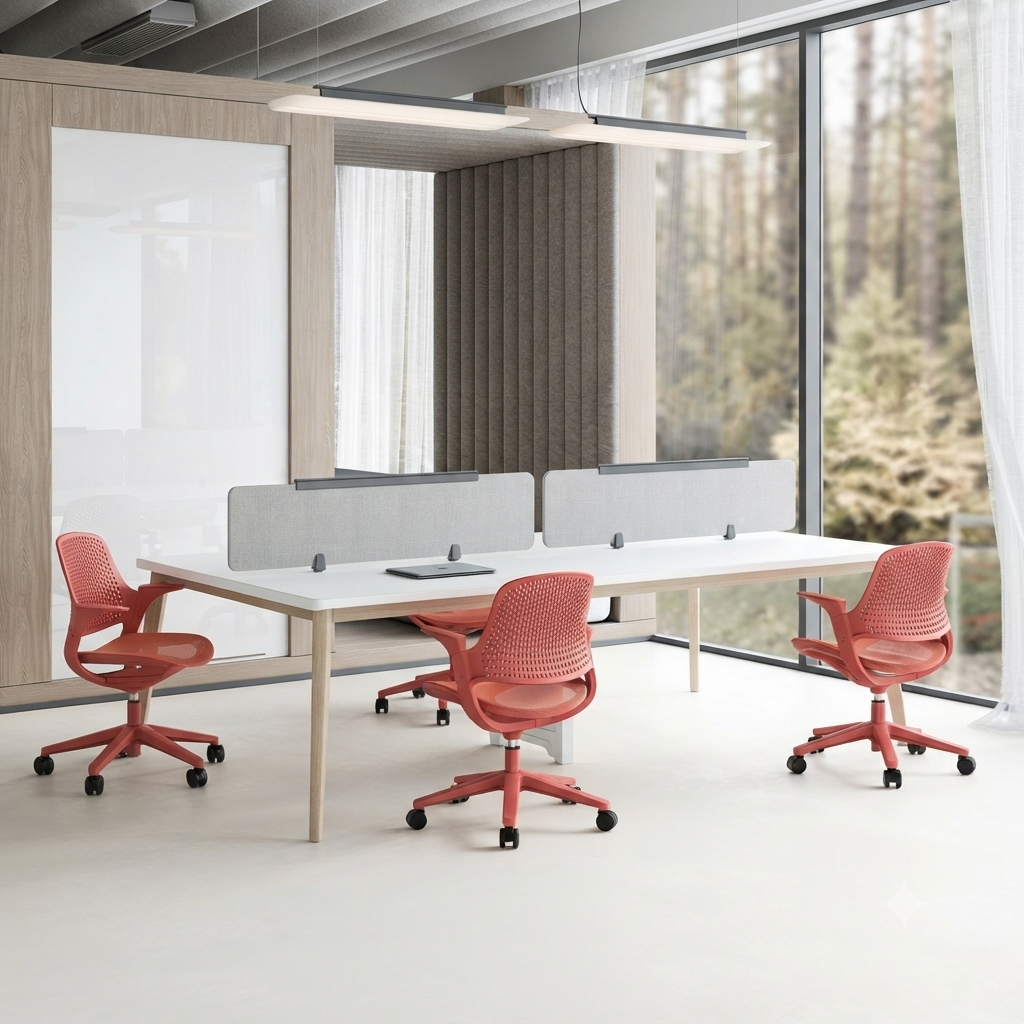

Ergonomic Task Chair Breathable Mesh Office Seating
Inclusive workplace furniture can include:
Adjustable desk and chair settings.
Task lighting and glare control.
Quiet rooms and lower-stimulation areas.
High-back seating for visual and partial acoustic separation.
Clear circulation paths and accessible table heights.
A mix of open, semi-private and enclosed work settings.
Furniture finishes that are durable and easy to clean.
Accessible power outlets and charging positions.
Wellness principle: Do not assume every employee wants the same workstation. Offer a choice of settings while ensuring each option is safe, accessible and easy to maintain.
Hybrid work has made calls, video meetings and online collaboration more common. This creates a challenge in open offices: people need to speak without distracting colleagues or exposing private conversations.
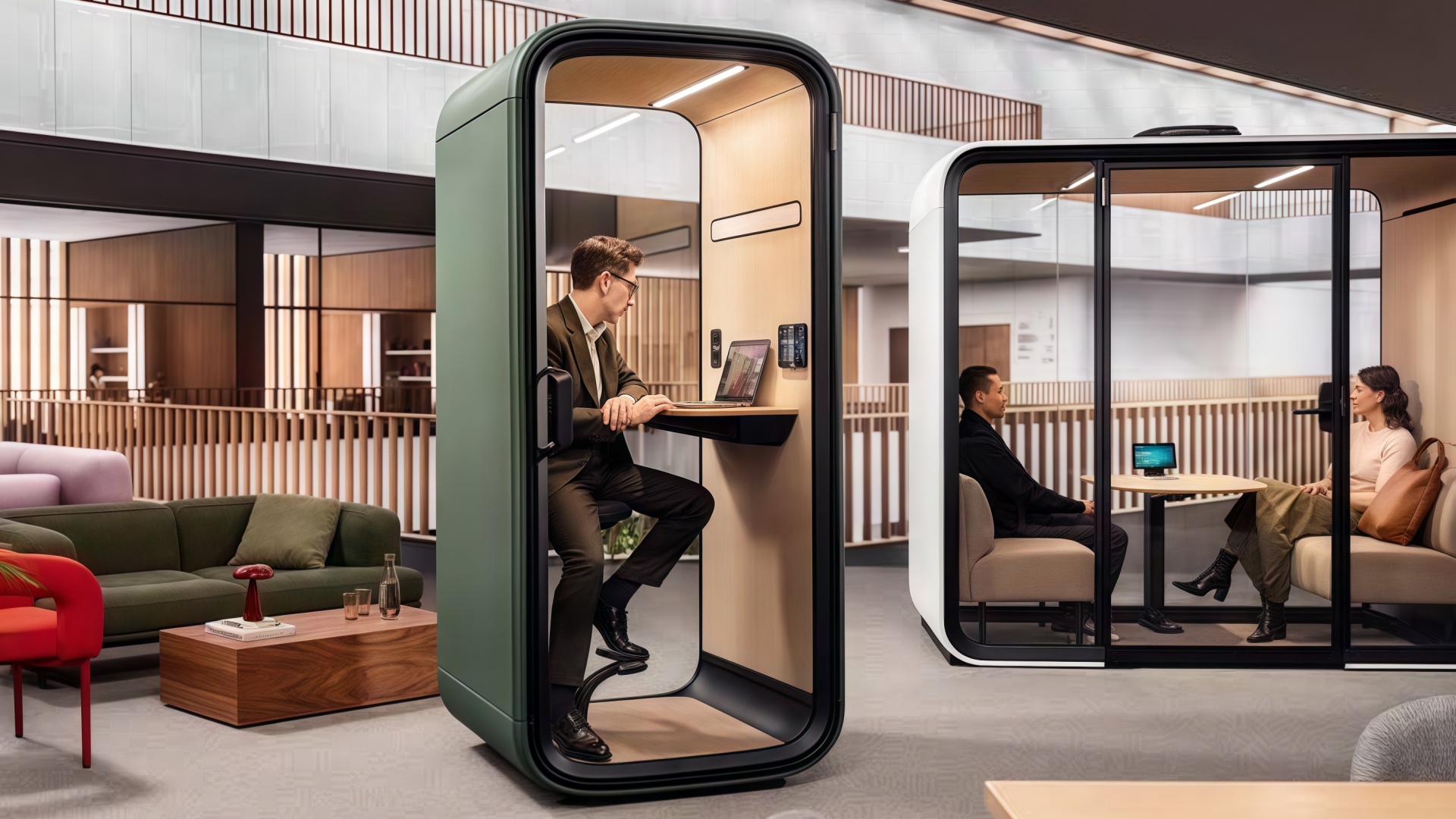
Acoustic office furniture can help, but it must be selected according to the actual problem.
Desk screens can reduce local speech and visual distraction.
Wall panels and ceiling baffles can reduce reflected sound and reverberation.
High-back lounges and booths can create semi-private conversation zones.
Phone pods can provide enclosed space for calls and video meetings.
| Acoustic Product | Key Specification | Common Mistake to Avoid |
Acoustic desk screen | Material absorption data, height, thickness and mounting method | Assuming a screen creates complete speech privacy |
Acoustic wall panel | NRC or equivalent data for the exact material and installation | Comparing panels without checking thickness or mounting system |
Ceiling baffle | Absorption data, spacing, suspension and fire requirements | Ignoring coordination with lighting, HVAC and sprinklers |
Phone pod | Speech-privacy data, ventilation noise, power and service access | Using only a generic STC claim |
High-back booth | Dimensions, upholstery durability and layout placement | Treating high-back seating as a substitute for enclosed meeting space |
Mobile screen | Stability, caster quality, lock function and storage plan | Choosing a screen that cannot be safely moved or stored |
For office pods, buyers should request configuration-specific speech privacy and ventilation information. ISO 23351-1 is relevant for laboratory measurement of speech-level reduction in furniture ensembles and enclosed office pods.hushoffice+1
For office-wide acoustic planning, ISO 3382-3 provides a method for measuring room-acoustic parameters in open-plan offices.
For a detailed acoustic procurement guide, read Open Plan Office Acoustics: Furniture Solutions for Noise Control.
Sustainable office furniture is moving beyond broad claims such as “eco-friendly” or “green materials.” Procurement teams increasingly ask for evidence that can be verified, including material declarations, product test reports, certificates, repair guidance and spare-part information.
The exact requirements vary by client, location, product category, building target and RFP. Therefore, buyers should request relevant evidence rather than assuming one certification applies to every furniture item.

| Requirement Area | Evidence to Request | Buyer Check |
Structural performance | Applicable BIFMA or ANSI performance evidence | Confirm the report covers the exact model and product category |
Low emissions | GREENGUARD Gold or equivalent product-level evidence | Confirm the actual product or material configuration is listed |
Wood traceability | FSC Chain of Custody documentation where required | Confirm certificate status, company name and scope |
Sustainability | BIFMA LEVEL evidence where the RFP requires multi-attribute sustainability | Verify LEVEL tier, product coverage and current status |
Electrical components | Destination-market electrical documentation | Confirm plug type, voltage and local installation requirements |
Repairability | Spare-part schedule, repair guide and component warranty | Confirm lead times for replacement hardware, upholstery and modules |
Packaging | Packing specification and material declaration | Balance reduced packaging with transit-damage protection |
UL GREENGUARD Gold relates to lower chemical emissions and should be checked at the product or material level. BIFMA LEVEL is a separate multi-attribute sustainability certification based on ANSI/BIFMA e3 criteria. It should not be confused with BIFMA performance standards for chairs, desks or storage.
Furniture with replaceable components often provides stronger lifecycle value than furniture that must be discarded after a minor failure.
Ask suppliers whether the following can be replaced:
Chair arm pads, casters, cylinders and mechanisms.
Desk control switches and sit-stand motors.
Drawer slides, hinges and locks.
Workstation screens and panel fabrics.
Power modules and cable-management components.
Lounge-seat cushions and upholstery covers.
Table bases, glides and connectors.
A repairable product can reduce downtime, protect visual consistency and extend the useful life of an office fit-out.

A per-person budget is useful for early planning, but it should never replace an itemised furniture schedule. Costs vary by location, workstation type, finish level, acoustic requirements, logistics, installation and technology integration.
Planning ranges only: The figures below are illustrative FOB China ranges. They exclude freight, duties, local installation, electrical work, IT, storage, taxes, design fees, acoustic measurements and project management.
| Package Level | Illustrative FOB Cost Per Person | Typical Scope |
Essential | $600–$900 | Workstation, task chair, basic storage and cable management |
Standard | $900–$1,400 | Enhanced workstation, ergonomic chair, privacy screen and shared collaboration furniture |
Premium | $1,400–$2,200 | Premium seating, acoustic privacy allocation, lounge furniture, modular elements and enhanced finishes |
| Cost Driver | Why It Changes Budget |
Workstation type | Fixed desks, sit-stand desks, benching and privacy level have different costs |
Chair adjustment level | Basic task seating costs less than fully adjustable ergonomic seating |
Power and data | Cable trays, desktop modules, monitor arms and IT coordination add scope |
Acoustic privacy | Pods, panels, ceiling treatment and installation can materially increase cost |
Collaboration furniture | Lounge seating, mobile tables, whiteboards and AV coordination affect budget |
Materials and finishes | Veneer, laminate, fabric, metal, glass and recycled-content requirements vary |
Certification and testing | Project-specific performance and emissions evidence may require additional scope |
Logistics and installation | Destination, building access, phased delivery and local labour all affect landed cost |
For a full procurement and lifecycle-cost framework, read Office Furniture Procurement: B2B Buying Guide with Total Cost Analysis.
Before placing an office-furniture order, confirm:
Attendance and peak occupancy data have been reviewed.
Desk-sharing, assigned-desk and locker policies are defined.
Meeting-room, call-space and collaboration demand has been mapped.
Workstation specifications include power, cable management and monitor requirements.
Sit-stand desks include suitable height range, load capacity and warranty support.
Chairs include relevant performance evidence and replaceable components.
Acoustic products address a documented noise problem.
Phone pods include ventilation, electrical, access and maintenance specifications.
Layouts include focus, collaboration, call and recharge settings where needed.
Accessibility and inclusive-design requirements are reviewed.
Sustainability documents are verified for the specific products being ordered.
Repairability, spare parts and warranty scope are documented.
Freight, installation, warehousing and project management are included in the total budget.
A sample workstation, mock-up area or pilot zone is approved before full rollout.
Hongye Furniture Group supports office projects with workstation systems, sit-stand desks, task seating, modular benching, collaboration furniture, acoustic screens and selected phone-pod solutions.
For commercial office projects, Hongye can support:
Workplace furniture planning and product selection.
Custom workstation and desk-system engineering.
Sit-stand desk, task-chair and storage packages.
Modular benching and reconfigurable workstation components.
Lounge, café, meeting-room and collaboration furniture.
Acoustic screens, high-back seating and selected pod solutions.
Material, finish and upholstery sample approval.
Product drawings, warranty details and applicable documentation.
Export packing, logistics preparation and installation coordination.
Where sustainability documentation is required, Hongye can provide relevant records for eligible products or materials. Buyers should independently verify certificate scope, current validity and model coverage before approval.
Hongye may offer cost advantages for comparable specifications. However, procurement teams should compare landed cost, installation scope, product performance, warranty and lifecycle requirements line by line before making a decision.


The Place Business Center | Office Project By Hongye Furniture
The key themes are hybrid-ready workstations, activity-based workplace design, ergonomic adjustability, acoustic privacy, repairable products and more verifiable sustainability documentation. The correct priority depends on the organisation’s attendance patterns, workstyles, space constraints and operational data.
Sit-stand desks can be worthwhile when users can adjust them correctly, alternate posture regularly and use them with compatible monitor, power and cable-management systems. They should be evaluated as part of a wider ergonomic programme rather than treated as an automatic productivity investment.
Cost depends on product type, performance requirements and installation scope. Desk screens are generally less costly than phone pods, while enclosed pods also require ventilation, electrical components, delivery access, installation and maintenance planning. Compare complete landed and installed scope, not only the FOB price.
Certification requirements depend on the project, market and product category. Buyers may request applicable BIFMA performance evidence for commercial office furniture, GREENGUARD Gold or equivalent evidence for lower emissions, FSC documentation for wood traceability and BIFMA LEVEL where a multi-attribute sustainability requirement applies. Verify every certificate at the product, material or factory scope required by the project.
A basic office furniture package may begin with workstation, task chair, storage and cable-management costs. A higher budget may include ergonomic upgrades, acoustic products, lounge furniture, meeting-room furniture and technology integration. Always clarify whether a budget is FOB only or includes freight, duties, installation, local labour and project management.
The most important office furniture trend in 2026 is not a single product. It is using workplace data to understand how people actually work, then choosing furniture that supports those patterns.
Hybrid-ready desks, ergonomic seating, acoustic privacy, activity-based zones and repairable materials can all create value. However, each solution should answer a real operational need, be easy to maintain and fit within a realistic lifecycle budget.
When office furniture is selected through data, testing and clear procurement requirements, the result is not simply a more attractive workplace. It is a workplace that remains adaptable, comfortable and useful as teams, technology and work patterns continue to change.
No.1 Section, Heshan Industrial City, Heshan, Jiangmen, Guangdong, China
+86-133-9221-7708
Mon - Sat: 8 AM - 6PM
Sun: 11 AM - 3 PM