
 English
Views: 0 Author: Rebecca | Senior FF&E Procurement Specialist Publish Time: 2026-09-01 Origin: Site


A sit-stand desk price in 2026 can range from roughly $250 for a basic manual model to $1,800 or more for a commercial electric desk. For office buyers, however, the quoted desk price is only the starting point: freight, assembly, accessories, warranty terms, repair risk, and replacement cycles all affect the final sit-stand desk cost.
This sit-stand desk price guide compares manual, single-motor, dual-motor, and commercial contract-grade desks. It also explains how to estimate a realistic 5-year and 8-year total cost of ownership (TCO) before placing a bulk office furniture order. Public retail pricing illustrates the wide market range: current electric models can begin below $300 at promotion, while configured premium and commercial desks commonly reach $600–$1,200 or more.
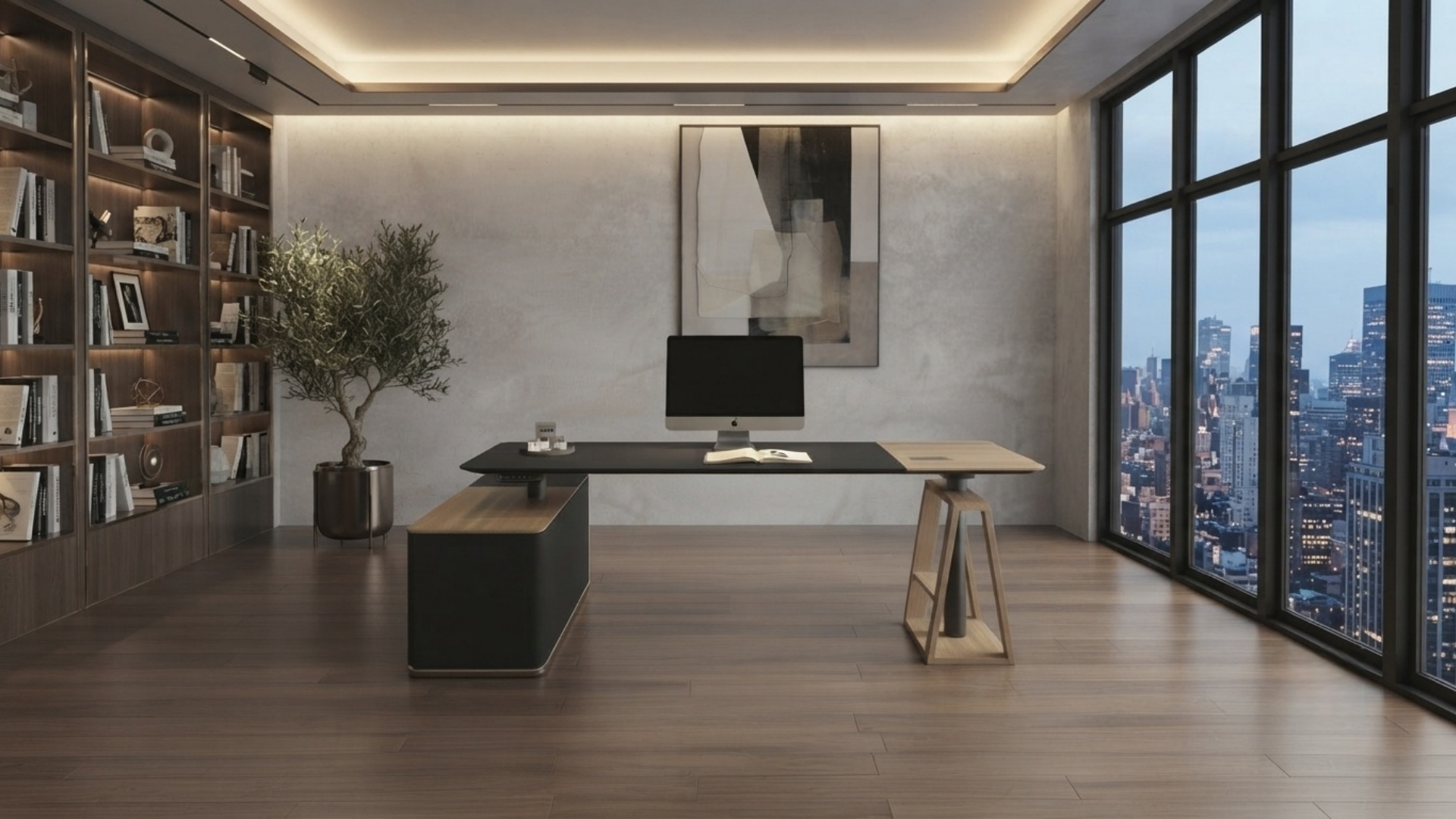
A sit-stand desk typically costs $250–$1,800 per unit in 2026, depending on its lifting system, frame construction, desktop size, worksurface material, included accessories, and commercial warranty.
Manual desks are usually best for light-duty or home-office applications; electric sit-stand desks are more practical for daily office use.
A dual-motor standing desk generally offers higher load capacity and more balanced lifting than a single-motor model, making it a stronger option for large desktops, multiple monitors, and frequently adjusted workstations.
The purchase price alone does not show the real sit-stand desk cost. Include freight, installation, monitor arms, cable management, spare parts, maintenance, and potential replacement.
For commercial projects, request model-specific test documentation, warranty coverage for the frame, motors, and electronics, and a complete bulk quotation before comparing suppliers.
This guide helps procurement teams, office managers, designers, and project buyers evaluate sit-stand desk prices using lifecycle value rather than sticker price alone. You will learn:
How manual, single-motor, dual-motor, and commercial sit-stand desks differ in price and performance
What drives electric sit-stand desk prices, including frame stability, lifting capacity, desktop material, and accessories
How to calculate 5-year and 8-year sit-stand desk total cost of ownership
Which hidden costs should be included in a commercial sit-stand desk budget
How to evaluate desk certifications, sample testing, warranty coverage, and supplier quotations
A sit-stand desk price in 2026 generally falls into four practical tiers:
Entry manual desks: approximately $250–$450
Mid-range single-motor electric desks: approximately $400–$700
Premium dual-motor electric desks: approximately $600–$1,200
Commercial contract-grade desks: approximately $900–$1,800+
These are planning ranges rather than fixed market prices. Actual quotations vary by desktop dimensions, destination country, shipping terms, local electrical requirements, order quantity, installation complexity, and whether the desk includes monitor arms, power modules, cable trays, CPU holders, or privacy accessories.
For example, publicly listed electric desks currently range from lower-priced entry products to configurations exceeding $1,000, depending on size, worksurface, frame configuration, and warranty package.
| Tier | Typical price per desk | Drive system | Frame and columns | Typical application | Planning lifespan |
Entry manual | $250–$450 | Manual crank | Light-duty steel frame | Home offices, occasional use | 3–5 years |
Mid single-motor | $400–$700 | One motor / linked lifting system | Standard steel frame | Small offices, light-to-moderate use | 3–6 years |
Premium dual-motor | $600–$1,200 | Dual motors | Heavier steel, often three-stage columns | Daily professional office use | 6–10 years |
Commercial contract-grade | $900–$1,800+ | Dual motor plus commercial control system | Heavy-duty frame, tested configuration | Enterprise offices, co-working, project furniture | 8–12 years |
Planning lifespan depends on actual lifting cycles, desktop load, user behavior, maintenance, warranty support, and local spare-part availability. It should not be treated as a universal performance guarantee.
A sit-stand desk used occasionally with a laptop has very different requirements from a shared office workstation supporting two monitors, a docking station, a CPU mount, and three to ten height changes per day. The intended duty cycle should guide the specification.

Electric sit-stand desk price differences are not driven by desktop appearance alone. The most important cost factors are the lifting system, frame design, stability at standing height, warranty coverage, and serviceability.
| Component | Lower-cost specification | Higher-value commercial specification | Why it affects long-term cost |
Drive system | Manual crank or basic single motor | Dual motors with synchronized control | Affects lifting capacity, balance, speed, and repair risk |
Frame and columns | Light steel, two-stage columns | Heavy-gauge steel, three-stage columns | Affects wobble, stability, load performance, and durability |
Desktop | Particleboard or thin laminate | Durable laminate, veneer, solid wood, or specialty surfaces | Affects appearance, scratch resistance, edge durability, and replacement cost |
Control system | Up/down button | Memory presets, anti-collision, lockout, control-box diagnostics | Improves convenience, safety, and facility management |
Accessories | Sold separately | Cable tray, grommets, monitor arm, CPU holder, power module included | Changes the delivered cost per workstation |
Testing and warranty | Limited coverage | Documented testing and multi-year motor/electronic warranty | Reduces procurement and maintenance uncertainty |
Project service | Boxed delivery only | Bulk shipping, installation support, spare parts, project coordination | Reduces rollout risk for offices with many desks |
A manual standing desk may be suitable for users who change height only occasionally. However, manual adjustment makes frequent posture changes less convenient, so many users leave the desk in one position.
A single-motor electric sit-stand desk can be adequate for a light-duty workstation with a compact desktop and moderate load. It is often chosen for smaller offices because it lowers the initial electric sit-stand desk price.
For commercial use, a dual-motor standing desk is usually preferable when the desk will carry multiple monitors, a large desktop, a CPU holder, heavy equipment, or frequent lifting cycles. Dual motors generally raise both sides of the frame in a more balanced way and commonly support higher rated loads than basic single-motor designs. This does not mean every dual-motor desk automatically has better quality; buyers should still request product-specific load ratings, stability information, warranty terms, and test documentation.
Many buyers spend too much time comparing laminate, veneer, and wood finishes while underestimating the importance of the steel frame. A visually attractive desktop cannot compensate for a desk that wobbles at standing height or struggles under a typical office load.
When testing a desk, evaluate:
Side-to-side wobble at the user's normal standing height
Front-to-back movement during typing
Stability with monitors mounted on arms
Lifting speed and noise level
Anti-collision response
Cable movement during travel
Frame performance at the maximum rated load
For North American commercial projects, ANSI/BIFMA X5.5-2021 provides a framework for evaluating the safety, durability, and structural performance of desk and table products used in commercial, institutional, and educational environments. For European projects, buyers should confirm which relevant EN 527 requirements apply to the specific desk configuration, including dimensions, safety, strength, and durability expectations.


Focus Pod Workstation Sit To Stand Mini Desk Solution
The lowest sit-stand desk price is not always the lowest-cost decision. A more accurate comparison includes every cost required to put a functional desk into service and keep it operating through the planning period.
Use the following calculation for each desk option:
5-Year TCO = Desk Purchase Price + Freight+Installation + Accessories + Expected Repairs + Replacement Cost − Residual Value
For a project with multiple desks:
Project TCO = TCO per Desk × Number of Desks
To compare options over time:
Cost per Desk-Day=Planning Period in DaysTotal Ownership Cost
The figures below are illustrative budgeting assumptions for a standard office desk, not universal market failure-rate forecasts. Your actual model should use supplier quotations, local freight terms, project installation costs, and documented warranty coverage.
| Cost item | Entry manual desk | Premium dual-motor desk | Commercial contract desk |
Typical purchase price | $300 | $900 | $1,300 |
Freight and delivery allowance | $50 | $60 | $80 |
Installation / assembly | $30 | $40 | $50 |
Cable tray, grommets, monitor support | $80 | $80 | Included or project-priced |
Repair reserve over five years | $30 | $70 | $100 |
Replacement allowance within five years | $350 | $0 | $0 |
Estimated 5-year TCO | $840 | $1,150 | $1,530 |
Estimated cost per desk-day | $0.46 | $0.63 | $0.84 |
At a strict five-year horizon, a manual desk may appear cheapest. But this is not always the correct planning horizon for an office project. The entry-tier desk may require replacement before the organization’s lease term ends, may not support heavier workstations, and may provide less consistent employee experience.
| Lifecycle measure | Entry manual desk | Premium dual-motor desk | Commercial contract desk |
Initial 5-year TCO | $840 | $1,150 | $1,530 |
Additional replacement or repair assumption, years 6–8 | $380 replacement / re-installation | $150 maintenance reserve | $180 maintenance reserve |
Estimated 8-year lifecycle cost | $1,220 | $1,300 | $1,710 |
Estimated 8-year cost per desk-day | $0.42 | $0.45 | $0.59 |
Best fit | Light use, cost-sensitive environments | Daily professional use | High-use, standardized commercial projects |
The lesson is not that one tier is always best. Instead:
Choose entry manual desks when adjustment frequency is low, loads are light, and replacement risk is acceptable.
Choose premium dual-motor desks when daily flexibility, higher load capacity, and standing-height stability matter.
Choose commercial contract desks when long warranties, standardized specifications, tested performance, service support, brand consistency, and predictable procurement matter more than lowest initial cost.
For a 20-desk office, the difference between a $300 desk and a $1,300 desk can look dramatic upfront. Yet the practical decision should include uptime, employee comfort, warranty response, installation disruption, spare parts, visual consistency, and replacement timing—not just the first purchase order.


A sit-stand desk quotation may exclude several items required for a complete workstation. Before comparing prices, confirm what is included and what is optional.
| Hidden cost | Typical planning range | Questions to ask suppliers |
Freight and inland delivery | $40–$120 per desk | Is delivery included? Does the quote include duties, local trucking, or liftgate service? |
Installation and assembly | $30–$80 per desk | Is the desk delivered assembled, flat-packed, or installed on site? |
Cable management | $20–$60 per desk | Are cable trays, vertical cable spines, and grommets included? |
Monitor arms | $40–$150 per arm | Does the desk frame remain stable with single or dual monitor arms? |
Power modules | $50–$200 per desk | Are power modules certified for the destination market? |
CPU holders | $30–$100 per unit | Does the lifting capacity include the CPU holder and computer weight? |
Motor or control-box replacement | $80–$250+ per component | Are motors, control boxes, and handsets covered separately? |
Existing desk removal | $10–$30 per desk | Who removes, recycles, stores, or resells old furniture? |
Spare parts and service | Project-dependent | Are motors, handsets, columns, and control boxes available locally? |
User onboarding | Minimal to moderate | Will users receive guidance on safe setup, memory settings, and cable use? |
For international projects, clarify whether the quotation uses EXW, FOB, CIF, DDP, or another Incoterm. A low EXW sit-stand desk price can become much higher after export packaging, container loading, ocean freight, customs clearance, duties, inland delivery, and installation.
Before placing a bulk order, use this commercial sit-stand desk procurement checklist to compare suppliers on performance, cost, delivery risk, and warranty support—not only quoted unit price.
Define the duty cycle: Estimate how often users will change desk height each day. A shared workstation with frequent adjustments has different needs from a private desk adjusted once or twice daily.
Set desktop size and load requirements: Confirm the desktop width and depth, monitor count, CPU mounting, power modules, and total equipment load. Do not compare frame capacity without including all workstation accessories.
Choose the correct drive system: Manual desks may suit occasional use. Single-motor desks can suit light-duty applications. For frequent adjustment, heavier equipment, larger desktops, or shared workstations, evaluate dual-motor systems.
Request test and compliance documentation: For U.S. commercial applications, request ANSI/BIFMA X5.5-2021 documentation for the relevant desk configuration. For European projects, confirm applicable EN 527 requirements and destination-market electrical compliance.
Compare warranties by component: Ask separately about the warranty for the steel frame, lifting columns, motors, control box, handset, desktop, and accessories. “Five-year warranty” is not meaningful unless the covered components are listed.
Price a complete workstation: Include cable management, monitor arms, power modules, CPU holders, privacy screens, delivery, installation, and tax or duty assumptions.
Order samples before committing: Test one or two desks at real working height. Check wobble, noise, cable travel, anti-collision response, and control reliability with the intended monitor setup.
Plan service and spares: For large projects, consider a small spare-parts package or a defined service arrangement. This may include spare handsets, control boxes, motors, or replacement columns.
Schedule user onboarding: A desk only supports movement if employees understand how to adjust it safely and use memory settings. A short introduction can improve adoption and reduce misuse.


Height Adjustable Executive Desk Modern CEO Workstation
A single-motor electric sit-stand desk is not automatically a poor choice. It can be suitable when the workstation has a compact desktop, light equipment, low adjustment frequency, and a user who does not require high standing-height stability.
A single-motor model may fit:
A home office with a laptop and one lightweight monitor
A private office with one user and limited lifting cycles
A temporary project workspace
A low-budget office where desk replacement is acceptable
A workstation without heavy monitor arms, CPU holders, or large desktop loads
A dual-motor standing desk is generally more suitable when the desk is used by multiple people, adjusted repeatedly throughout the day, equipped with multiple monitors, used at higher standing positions, or specified for a long-term commercial workplace.
Certifications do not replace a physical sample test, but they reduce purchasing risk. They show that the supplier has considered defined performance criteria rather than relying only on product appearance or price.
| Requirement | Why it matters | What to verify |
ANSI/BIFMA X5.5-2021 documentation | Evaluates safety, durability, and structural performance of desk and table products | Ask whether documentation applies to the exact desk configuration |
EN 527 documentation | Relevant European office-table standards | Confirm applicable parts for dimensions, safety, strength, and durability |
Electrical compliance | Required for motors, control boxes, power modules, and plugs | Confirm destination-market voltage, plug type, and approvals |
Board emission documentation | Helps assess worksurface material suitability | Ask for E1, ENF, CARB Phase 2, TSCA Title VI, or applicable local documentation |
Warranty schedule | Shows who carries long-term repair risk | Separate coverage for frame, motor, control box, handset, and desktop |
Spare-part availability | Protects the project after warranty | Ask about lead times, pricing, and local or regional support |
Third-party test reports | Supports performance claims | Verify report date, laboratory, tested model, and configuration |
ANSI/BIFMA X5.5-2021 provides a common basis for evaluating the safety, durability, and structural performance of desk and table products intended for commercial office, institutional, educational, retail, restaurant, and cafeteria environments. It is useful for procurement, but buyers should confirm that the supplier's documentation applies to the exact model, desk size, frame, worksurface, and configuration being purchased.
A good sit-stand desk generally costs $600–$1,200 for a premium dual-motor model and $900–$1,800+ for a commercial contract-grade desk. The best choice depends on how often the desk is adjusted, how much equipment it carries, how stable it must be at standing height, and what warranty support is included. A lower-cost manual or single-motor desk can be adequate for light-duty use, but it may not be ideal for a high-use office workstation.
For frequently adjusted office desks, large desktops, multi-monitor workstations, and shared work environments, a dual-motor sit-stand desk is often worth the additional cost. It generally provides more balanced lifting and higher capacity than basic single-motor designs. However, do not select solely on motor count—also compare stability, rated load, warranty coverage, test documentation, spare-part availability, and local installation support.
The cheapest long-term approach is not always buying the lowest-cost desk. Start by standardizing desk size, desktop finish, power configuration, and accessories. Use bulk purchasing where appropriate, confirm which accessories are included, choose durable laminate instead of expensive custom surfaces when appearance allows, and negotiate freight and installation as part of the project package. For heavy daily use, compare 8-year lifecycle cost rather than only purchase price.
A commercial electric sit-stand desk may serve for many years, but lifespan depends on duty cycle, load, frame quality, motor and control-box quality, maintenance, user behavior, and warranty support. A light-use desk may last longer than its warranty period, while a frequently adjusted shared desk may need service sooner. Request the supplier’s load rating, warranty schedule, expected service process, and spare-part plan instead of relying on broad lifespan claims.
For North American commercial projects, request ANSI/BIFMA X5.5-2021 compliance information or third-party documentation for the relevant desk configuration. For European projects, ask which EN 527 requirements apply. Also verify destination-market electrical compliance for motors and power modules, along with applicable board-emission documentation for the desktop. BIFMA's X5.5 standard addresses safety, durability, and structural performance for desk and table products.
A complete quotation should state the desk frame model, motor configuration, lifting range, load rating, desktop dimensions and material, control type, anti-collision features, cable-management components, monitor arms, power modules, packaging, Incoterms, freight, installation scope, lead time, warranty by component, and spare-part pricing. Without this detail, two sit-stand desk prices are rarely comparable.
Hongye Furniture Group supplies commercial office furniture for project buyers, including electric sit-stand desks, task seating, workstations, storage, and meeting-room furniture. For sit-stand desk projects, Hongye can support configurations with dual-motor frames, three-stage lifting columns, memory controls, anti-collision functions, cable management, power options, and desktops selected to match office design and budget requirements.
When comparing a commercial sit-stand desk price, request a quotation that separates the desk frame, desktop, accessories, freight, installation, warranty coverage, spare parts, and lead time. This makes it easier to compare true project cost rather than choosing based on a low initial unit price.

Hongye can help office managers, designers, dealers, and procurement teams evaluate manual, single-motor, dual-motor, and contract-grade desk options through a project-specific TCO comparison. For large office orders, request:
A sit-stand desk quotation based on your required desk count and desktop size
Product specifications covering load capacity, lifting range, stability, and included accessories
Available test and compliance documentation for the selected configuration
Warranty terms for the frame, motors, electronics, desktop, and accessories
A sample desk or mock-up for real-world stability and usability testing
In a market where low headline prices can hide limited warranty coverage, missing accessories, weak frames, or unavailable replacement parts, transparent specifications and lifecycle planning protect both the purchaser's budget and the employee experience.
No.1 Section, Heshan Industrial City, Heshan, Jiangmen, Guangdong, China
+86-133-9221-7708
Mon - Sat: 8 AM - 6PM
Sun: 11 AM - 3 PM