
 English
Views: 0 Author: Site Editor Publish Time: 2026-08-03 Origin: Site


If you are choosing between sintered stone and quartz for a kitchen countertop, a bathroom vanity, or a commercial bar top, you have probably noticed that both materials get marketed with similar language. Both are engineered. Both are durable. Both come in large slabs with marble-like patterns. The packaging looks comparable, so buyers assume the materials are comparable.
They are not. The manufacturing processes are fundamentally different, and those differences create real, measurable gaps in performance that show up the first time someone sets a hot pan on the surface, spills red wine overnight, or installs the material in a sunlit lobby.
TAULA by Fit Sintered Stone Technology has been fabricating both materials for hotel, restaurant, and residential projects across Asia, the Middle East, and Central Asia for years. This comparison draws on that fabrication experience and standardized testing data — not brochure claims — to explain where each material genuinely wins and where the trade-offs are real.
────────────────────────────────────────────────────────────
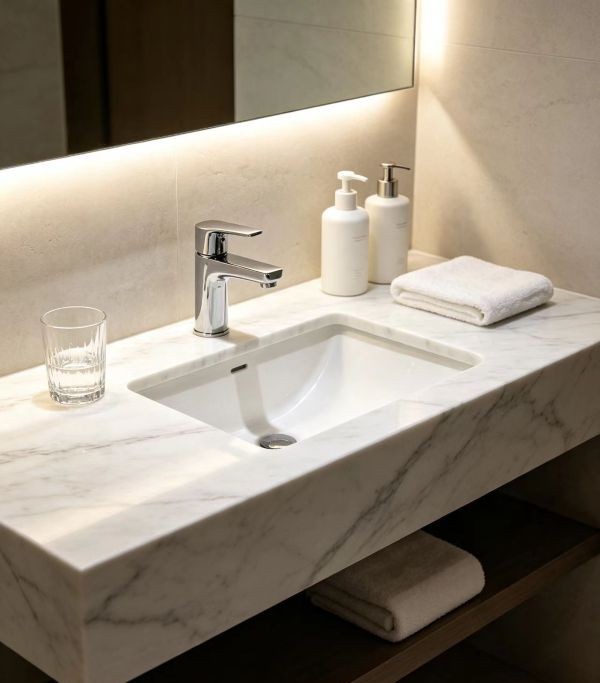
Quartz countertops are engineered stone made from roughly 90-93% crushed natural quartz mixed with 7-10% polymer resin binder, pigments, and sometimes recycled glass or metallic flecks. The mixture is pressed into slabs at room temperature and cured in ovens at around 80-90°C. The resin does the heavy lifting: it binds the quartz particles together, creates a non-porous surface, and allows manufacturers to produce consistent colors and patterns reliably.
Sintered stone takes a completely different route. Natural mineral powders — feldspar, quartz, clay, and mineral oxides — are compacted at pressures exceeding 400 bar and fired at temperatures above 1,200°C. No resin. No chemical binder. The sintering process fuses the mineral particles together the same way nature forms granite — just much faster. The result is a material that is 100% mineral, with no organic component that can degrade over time.
Property | Sintered Stone | Engineered Quartz |
Composition | 100% natural minerals (feldspar, quartz, clay, oxides) | ~90% quartz + ~10% resin binder |
Manufacturing pressure | 400+ bar (4,000+ kg/cm²) | Pressed at moderate pressure |
Firing temperature | 1,200-1,400°C | 80-90°C (oven-cured) |
Binder | None — minerals self-fuse | Polymer resin (epoxy/polyester) |
Body structure | Through-body (color runs throughout) | Surface layer on composite body |
Recyclability | Fully recyclable (crush and re-fire) | Limited (resin prevents full recycling) |
The resin in quartz is the single most important factor distinguishing the two materials. It makes quartz easier and cheaper to manufacture, and it gives the surface a slight flex that can be an advantage during installation. But it also introduces three weaknesses that sintered stone does not share: UV sensitivity, heat sensitivity, and long-term aging.
────────────────────────────────────────────────────────────
Both materials are significantly harder than natural marble (Mohs 3-4), which is why both have become popular alternatives. But the gap between them is meaningful.
Durability Metric | Sintered Stone | Engineered Quartz |
Mohs hardness | 7-8 | 6-7 |
Flexural strength | ~50 N/mm² | ~35-40 N/mm² |
Impact resistance (edge) | High — through-body structure | Moderate — resin can chip at edges |
Scratch resistance | Excellent | Very good (quartz is hard, but resin can scratch) |
Chip repair | Difficult (same-color body helps conceal) | Moderate (resin fill possible but visible) |
In daily kitchen use, both resist scratching from knives and utensils. The difference emerges at edges and corners. Sintered stone's through-body composition means a chip reveals the same color underneath, making damage less noticeable. Quartz chips expose the resin-bound composite body, which often has a slightly different texture or color from the surface.
TAULA's fabrication team works with 6-axis CNC machining centers that cut both materials daily. The machining behavior tells the real story: sintered stone requires diamond tooling and slower feed rates, but cuts cleanly with minimal edge fraying. Quartz cuts faster but can produce edge chips where the resin fractures along the cut line — particularly on tight inside corners or waterfall edges.
────────────────────────────────────────────────────────────
This is the category where the manufacturing difference becomes most practical for homeowners and commercial operators.
Heat Test | Sintered Stone | Engineered Quartz |
Maximum surface temperature | Up to 1,200°C (fireproof) | Up to ~150°C (resin softens above this) |
Hot pan direct contact | Safe — no damage | Risk of resin discoloration or cracking |
Thermal shock (cold to hot) | No effect | Can cause micro-cracks in resin layer |
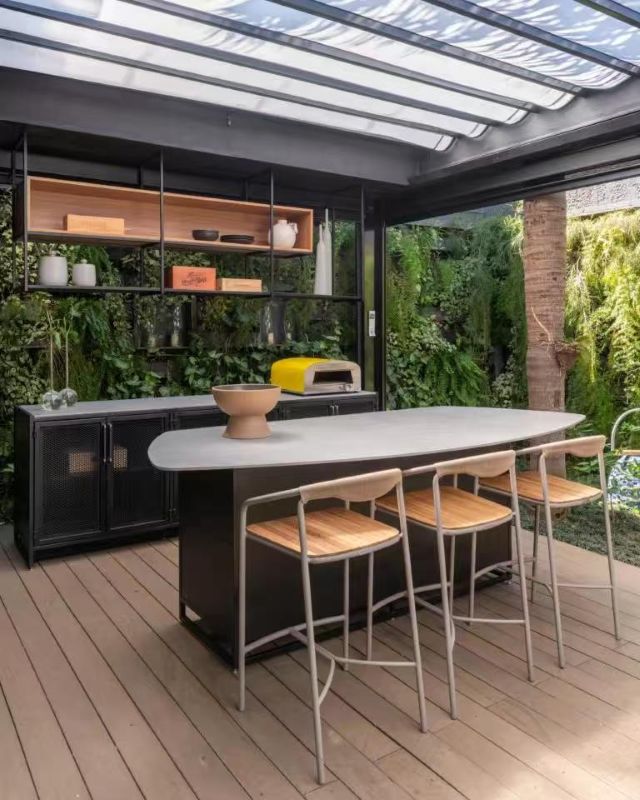
Outdoor kitchen suitability | Excellent | Not recommended (UV + heat) |
Quartz manufacturers warn against placing hot pans directly on the surface. The resin binder begins to soften and discolor at around 150°C, and a cast iron pan fresh off a burner can exceed 250°C. Prolonged heat exposure can cause permanent yellowing or even surface cracking where the resin expands at a different rate than the quartz particles.
Sintered stone has no resin to degrade. A pot pulled from a 200°C oven can be placed directly on the surface with zero risk. This is not a marketing claim — it is a direct consequence of the material being fired at 1,200°C during manufacturing. If the material survived that, your cooking temperatures are not a threat.
For commercial kitchens, outdoor bar tops, and hotel cooking stations, this difference is decisive. A quartz countertop in a restaurant kitchen will show heat damage within months. A sintered stone surface will not.
────────────────────────────────────────────────────────────
Both materials are marketed as non-porous and stain-resistant, and both perform well in this category. But the resin in quartz creates subtle vulnerabilities.
Stain/Chemical Test | Sintered Stone | Engineered Quartz |
Red wine (24-hour exposure) | No effect | No effect (if cleaned promptly) |
Coffee, tea, turmeric | No effect | Possible slight staining if resin is degraded |
Lemon juice / vinegar (acid) | No effect (chemically inert) | No effect (resin is acid-resistant) |
Nail polish remover (acetone) | No effect | Can soften resin surface over time |
Bleach (household) | No effect | Can dull surface with repeated exposure |
Permanent marker | Cleans off with alcohol | Cleans off, but may leave trace in resin |
The key insight: quartz's resin surface is generally resistant to household chemicals, but aggressive solvents — acetone, paint thinner, concentrated bleach — can degrade the resin over time. Sintered stone, being 100% mineral with no organic component, is chemically inert to virtually all household and commercial cleaning chemicals.
For a residential kitchen, this difference rarely matters. For a commercial bar, a hotel housekeeping station, or a laboratory surface, it can be the deciding factor.
────────────────────────────────────────────────────────────
If your project involves any sun exposure — an outdoor kitchen, a sunlit lobby, a poolside bar, or a window-side vanity — this category eliminates quartz as an option.
UV Exposure Scenario | Sintered Stone | Engineered Quartz |
Direct sunlight (indoor, window-side) | No effect | Resin yellows over 2-5 years |
Outdoor kitchen countertop | Excellent — no degradation | Not recommended |
Poolside bar top | Excellent — UV and chlorine resistant | Not recommended |
Sunlit lobby feature wall | No fading | Visible yellowing within 3 years |
The polymer resin in quartz is an organic compound, and organic compounds degrade under UV radiation. This is not a defect — it is chemistry. Quartz manufacturers explicitly state that their products are for indoor use only. Sintered stone, with no organic component, is completely UV-stable and suitable for outdoor applications.
────────────────────────────────────────────────────────────
Aesthetic Factor | Sintered Stone | Engineered Quartz |
Marble reproduction (Calacatta, Statuario) | Excellent — digital printing + mineral pigments | Good — but veining is surface-only |
Solid colors | Wide range, through-body | Wide range, consistent |
Texture options | Smooth, matte, polished, leathered | Smooth, polished, matte |
Slab sizes | Up to 3,200 x 1,600mm | Up to 3,200 x 1,600mm (some manufacturers) |
Pattern consistency between slabs | Moderate (each slab unique) | High (engineered consistency) |
Visible seams | Minimal (large slabs reduce seam count) | Minimal |
Quartz has an edge in pattern consistency — if you need six slabs that look identical, quartz can deliver that more reliably. Sintered stone tends toward more natural variation between slabs, which designers working on luxury projects often prefer but which can complicate large commercial installations where visual uniformity matters.
────────────────────────────────────────────────────────────
Cost Factor | Sintered Stone | Engineered Quartz |
Material cost (per m², 12mm) | $80-180 | $50-120 |
Fabrication cost | Higher (slower cutting, diamond tooling) | Lower (faster cutting, standard tooling) |
Installation cost | Similar | Similar |
Installed cost (per m², residential) | $150-300 | $100-200 |
10-year maintenance cost | $0 (no sealing) | $0-200 (occasional resealing) |
Replacement frequency (commercial) | 15-20+ years | 8-12 years (UV/heat damage) |
Sintered stone costs more upfront — typically 30-50% more than comparable quartz. The gap narrows when you factor in lifecycle costs for commercial projects, where quartz may need replacement due to heat or UV damage while sintered stone does not.
────────────────────────────────────────────────────────────
When the Grand Kempinski Hotel project required stone surfaces for its lobby reception desk, bar area, and restroom vanities, the design team evaluated both sintered stone and quartz. The decision came down to three factors:
Heat exposure at the bar: The lobby bar serves hot beverages and food, with service staff placing warm plates directly on the surface. Quartz's heat limitation was a disqualifier for the bar counter.
UV exposure in the lobby: Floor-to-ceiling windows bathe the reception area in direct sunlight for several hours daily. Over a 10-year horizon, quartz's UV yellowing would have required replacement. Sintered stone's UV stability eliminated this risk.
Chemical exposure in restrooms: Hotel housekeeping uses commercial-grade disinfectants daily. Sintered stone's chemical inertness ensured the vanity surfaces would maintain their finish through years of aggressive cleaning.
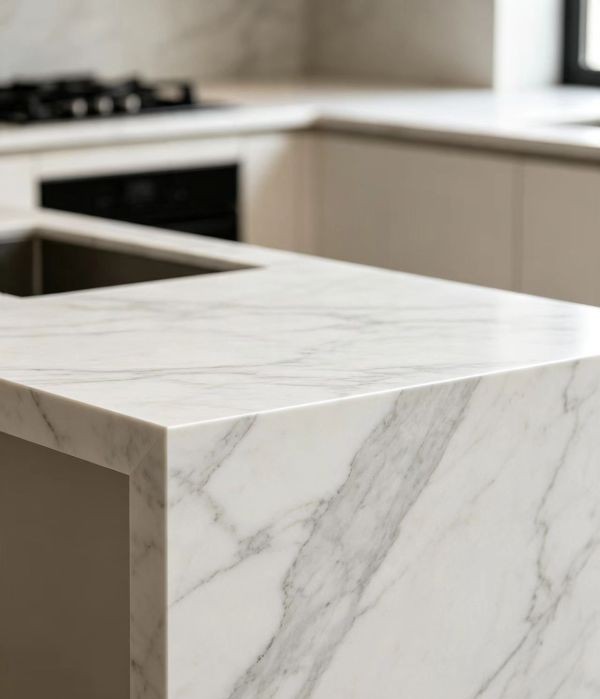
The final specification used TAULA sintered stone for all three applications — reception desk, bar counter, and restroom vanities — with custom cut-to-size fabrication on 6-axis CNC equipment to achieve the waterfall edge profiles the design team specified.
────────────────────────────────────────────────────────────
· Your surface will receive direct sunlight (outdoor kitchen, sunlit lobby, window-side counter)
· Hot pans will contact the surface (commercial kitchen, cooking station, bar top)
· The project is commercial and needs 15+ year lifespan without replacement
· You want through-body color (chips and edges are less visible)
· The surface will be exposed to aggressive cleaning chemicals
· Budget is the primary constraint and the surface is fully indoor
· You need exact pattern consistency across multiple slabs
· The project is residential and the surface will not see direct sun or high heat
· You want the widest range of colors and patterns at a lower price point
────────────────────────────────────────────────────────────
Is sintered stone more expensive than quartz?
Yes, typically 30-50% more expensive for the material itself, plus higher fabrication costs due to slower cutting speeds and diamond tooling requirements. However, for commercial projects or sunlit installations, the lifecycle cost of sintered stone is lower because it does not require replacement due to UV or heat damage.
Can you put a hot pan on sintered stone?
Yes. Sintered stone is fired at 1,200°C during manufacturing and can withstand temperatures up to 1,200°C without damage. A hot pan from a 250°C oven can be placed directly on the surface.
Can you put a hot pan on quartz?
No. Quartz surfaces contain polymer resin that begins to soften and discolor at around 150°C. Direct contact with hot cookware can cause permanent yellowing, surface burns, or thermal shock cracking. Always use a trivet on quartz.
Does sintered stone need to be sealed?
No. Sintered stone is non-porous (water absorption below 0.1%) and requires no sealing at any point during its lifespan. Quartz also does not require sealing, though some manufacturers recommend occasional resealing of the resin surface.
Which material is better for outdoor kitchens?
Sintered stone is the clear choice for outdoor applications. It is completely UV-stable, frost-resistant (no damage after 50 freeze-thaw cycles per EN 10545-12), and unaffected by rain, chlorine, or temperature fluctuations. Quartz is not rated for outdoor use.
Can sintered stone be repaired if chipped?
Yes, but repairs are more difficult than on quartz. Because sintered stone is extremely hard, chip repair requires specialized epoxy fillers color-matched to the surface. The through-body composition means the repair area is less visible than on quartz, where a chip exposes the composite body. TAULA's fabrication team offers repair services for installed surfaces.
Which material has more color options?
Quartz generally offers a wider range of consistent solid colors and patterns due to the engineered manufacturing process. Sintered stone offers excellent marble reproductions and natural-looking patterns but with more variation between slabs. If you need six identical slabs, quartz may be the better choice.
How do I clean sintered stone countertops?
Use any household cleaner — including bleach, acetone, or abrasive cleaners. Sintered stone is chemically inert and will not be damaged by any standard cleaning product. For daily maintenance, warm water and mild soap are sufficient.
────────────────────────────────────────────────────────────
The manufacturing difference — resin-bonded versus sintered mineral — is not a technical footnote. It is the reason one material goes yellow in the sun and the other does not. It is the reason one surface accepts a hot pan and the other warns you against it. Understanding that difference is the key to specifying the right material for the right project.
For custom sintered stone fabrication with 6-axis CNC precision, contact TAULA by Fit Sintered Stone Technology. Our team handles cut-to-size projects for hotels, restaurants, villas, and commercial spaces across Asia, the Middle East, and Central Asia.
No.1 Section, Heshan Industrial City, Heshan, Jiangmen, Guangdong, China
+86-137-0227-9783
Mon - Sat: 8 AM - 6PM
Sun: 11 AM - 3 PM